In Part 1 and Part 2, we built our HTTP/3 framing, QPACK encoder and decoder, control streams, and HTTP/3 server and client in Go. At the end of Part 2, our code could talk to curl, quic-go, and Chrome, but we were still relying on quic-go to handle the UDP sockets and QUIC streams.
In this post, we’ll remove quic-go, build a minimal QUIC layer directly on top of UDP, and use it to fetch https://kmcd.dev/ over HTTP/3.
Why UDP?
At the end of HTTP/2 From Scratch: Part 4, I talked about why HTTP/2 only solved head-of-line blocking at the application layer. Since HTTP/2 multiplexes all of its streams over a single TCP connection, it still inherits TCP’s strict sequential packet ordering. Drop a single TCP packet on Stream 0, and the OS sits on data for Stream 4 in the kernel’s TCP receive buffer while waiting for the retransmit:
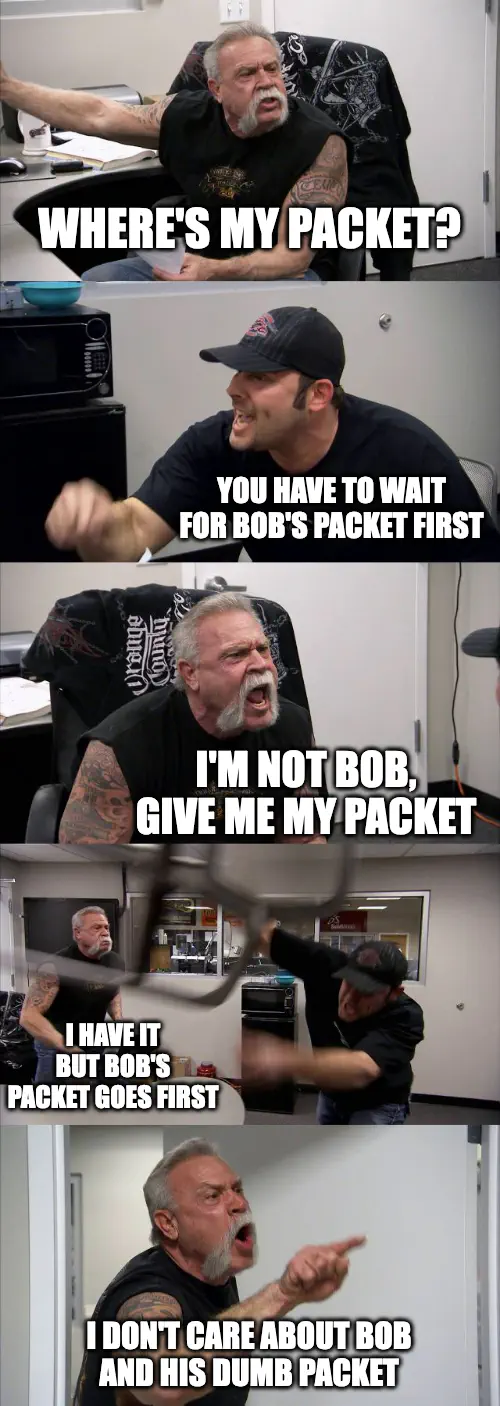
QUIC (RFC 9000, which is a pretty sweet RFC number) ditches TCP altogether and runs straight over UDP (net.ListenPacket("udp", addr)).
Inside a Packet
What’s inside a QUIC UDP datagram?
Look at the highest bit (0x80) of the first byte we read from net.PacketConn to see which of the two RFC 9000 packet headers is on the wire (1 for a handshake Long Header, 0 for a 1-RTT Short Header):
Here is how we model those packet headers and their decrypted QUIC frames in quic_frame.go:
type Packet struct {
    IsLongHeader bool
    LongType     uint8
    Version      uint32
    DestConnID   []byte
    SrcConnID    []byte
    PacketNumber uint32
    Frames       []QUICFrame
}

type QUICFrame struct {
    Type         uint64
    StreamID     uint64
    Offset       uint64
    Fin          bool
    Data         []byte
    LargestAcked uint64
    CryptoOffset uint64
    CryptoData   []byte
    ErrorCode    uint64
    ReasonPhrase string
}
Stream Frames
Notice that HTTP/3 has frames (HEADERS, DATA, SETTINGS), and QUIC also has frames (CRYPTO, ACK, STREAM). The lowest three bits of the STREAM frame type byte act as presence flags for the fields that follow (0x04 for OFF, 0x02 for LEN, and 0x01 for FIN):
When writing a STREAM frame in quic_frame.go, we set those flags on the base type (0x08) and encode the fields using the varint helpers from Part 1:
frameType := QUICFrameStreamBase | StreamFlagLEN
if f.Offset > 0 {
    frameType |= StreamFlagOFF
}
if f.Fin {
    frameType |= StreamFlagFIN
}
buf = AppendVarint(buf, frameType)
buf = AppendVarint(buf, f.StreamID)
if f.Offset > 0 {
    buf = AppendVarint(buf, f.Offset)
}
buf = AppendVarint(buf, uint64(len(f.Data)))
buf = append(buf, f.Data...)
Look at the Stream ID field in the diagram above too. Remember in Part 1 and Part 2 how client request streams were numbered 0, 4, 8 while the control streams were 2 and 3? The lowest two bits of a QUIC stream ID are bitflags for who initiated the stream (0 for client, 1 for server) and whether it’s bidirectional (0) or unidirectional (1). Counting up client bidirectional streams by one actually increments the wire ID by four.
The Handshake
If we want to talk to https://kmcd.dev/ over UDP, we can’t send plaintext packets. Every QUIC packet on the wire, including the very first packet, is encrypted under RFC 9001.
In the HTTP/2 posts, we just handed a TCP net.Conn to tls.Client and let crypto/tls do the rest. With UDP there is no net.Conn to pass in, so we use Go’s tls.QUICClient and tls.QUICServer instead and carry the TLS 1.3 handshake bytes ourselves inside CRYPTO frames (which I wrote about in gRPC Over HTTP/3).
As the handshake steps through each encryption level, crypto/tls hands us a secret and a cipher suite. In derivePacketKeys, the cipher suite picks the hash and AES key size, while the "quic key", "quic iv", and "quic hp" labels derive three separate values from that one secret:
func derivePacketKeys(suite uint16, secret []byte) (*packetKeys, error) {
    var hashFunc func() hash.Hash = sha256.New
    keyLen := 16
    if suite == tls.TLS_AES_256_GCM_SHA384 {
        hashFunc = sha512.New384
        keyLen = 32
    }

    key := hkdfExpandLabel(hashFunc, secret, "quic key", nil, keyLen)
    iv := hkdfExpandLabel(hashFunc, secret, "quic iv", nil, 12)
    hpKey := hkdfExpandLabel(hashFunc, secret, "quic hp", nil, keyLen)

    block, err := aes.NewCipher(key)
    if err != nil {
        return nil, err
    }
    aead, err := cipher.NewGCM(block)
    if err != nil {
        return nil, err
    }
    return &packetKeys{aead: aead, iv: iv, hpKey: hpKey}, nil
}
When protectPacket sends a packet out, it XORs that 12-byte iv with the packet number in makeNonce, runs aead.Seal over the frames (passing the unencrypted header in as the additionalData parameter), and calls headerProtectionMask with hpKey to mask the packet number in the header.
Wait: how do we get a secret for the very first packet before the TLS handshake has even started? Both sides feed the client’s random Destination Connection ID and a hardcoded 20-byte salt from RFC 9001 Section 5.2 into derivePacketKeys so they can read and write those initial CRYPTO frames.
Building Streams
In quic_conn.go, handlePacket processes the frames from each decrypted packet:
func (c *quicConn) handlePacket(pkt Packet) {
    var shouldAck bool
    for _, f := range pkt.Frames {
        switch f.Type {
        case QUICFramePing, QUICFrameHandshakeDone, QUICFrameNewConnectionID:
            shouldAck = true

        case QUICFramePathChallenge:
            shouldAck = true
            _ = c.sendPacketAtLevel(level, []QUICFrame{{
                Type: QUICFramePathResponse,
                Data: f.Data,
            }})

        case QUICFrameCrypto:
            shouldAck = true
            if data := c.readCrypto(level, f.CryptoOffset, f.CryptoData); len(data) > 0 {
                _ = c.tlsConn.HandleData(tlsLevel, data)
                _ = c.drainTLSEvents()
            }

        case QUICFrameStreamBase:
            shouldAck = true
            c.getOrCreateStream(f.StreamID).pushFrame(f.Offset, f.Data, f.Fin)
        }
    }

    if shouldAck {
        _ = c.sendPacketAtLevel(level, []QUICFrame{{
            Type:         QUICFrameAck,
            LargestAcked: uint64(pkt.PacketNumber),
        }})
    }
}
Each stream in quic_conn.go implements Go’s io.Reader and io.Writer interfaces, storing incoming bytes in an s.chunks map by offset until our HTTP/3 parser calls Read at s.readOffset. If offset 6 shows up before offset 0, Read parks on s.cond.Wait() until offset 0 arrives, while other streams on the connection have their own quicStream state and keep running without waiting:
func (s *quicStream) pushFrame(offset uint64, data []byte, fin bool) {
    s.mu.Lock()
    defer s.mu.Unlock()

    if len(data) > 0 {
        s.chunks[offset] = bytes.Clone(data)
    }
    if fin {
        s.finReceived = true
        s.finOffset = offset + uint64(len(data))
    }
    s.cond.Broadcast()
}

func (s *quicStream) Read(p []byte) (int, error) {
    s.mu.Lock()
    defer s.mu.Unlock()

    for {
        if chunk, ok := s.chunks[s.readOffset]; ok {
            n := copy(p, chunk)
            delete(s.chunks, s.readOffset)
            if n < len(chunk) {
                s.chunks[s.readOffset+uint64(n)] = chunk[n:]
            }
            s.readOffset += uint64(n)
            return n, nil
        }
        if s.finReceived && s.readOffset >= s.finOffset {
            return 0, io.EOF
        }
        if s.closed {
            return 0, io.ErrClosedPipe
        }
        s.cond.Wait()
    }
}
The Result
Now quic-go is completely gone from go.mod! The only thing left in go.mod is golang.org/x/net, which we brought in back in HTTP/2 From Scratch: Part 4 for its HPACK/QPACK Huffman table.
$ go run .
URL:          https://kmcd.dev/
Proto:        HTTP/3.0
Status:       200 OK
Server:       cloudflare
Content-Type: text/html; charset=utf-8
Alt-Svc:      h3=":443"; ma=86400
Body Length:  26408 bytes
Body Preview: <!doctype html><html lang=en itemscope itemtype=https://schema.org/Blog><head><meta name=generator content="Hugo 0.152.2"><meta charset=UTF-8><meta http-equiv=X-UA-Compatible content="ie=edge"><meta n

$ go run . https://cloudflare-quic.com/
URL:          https://cloudflare-quic.com
Proto:        HTTP/3.0
Status:       200 OK
Server:       cloudflare
Content-Type: text/html
Alt-Svc:      h3=":443"; ma=86400
Body Length:  125959 bytes
Body Preview: <!DOCTYPE html>
<html lang="en" itemscope="" itemtype="http://schema.org/Article"><head><meta http-equiv="Content-Type" content="text/html; charset=UTF-8">
    <title>QUIC | Cloudflare</title>
    <me
Wrapping Up
Before you get any ideas: this is a terrible QUIC implementation. Remember at the beginning of the post when I talked about how QUIC avoids stalling other streams when a packet is lost? Well, our code doesn’t actually retransmit lost packets; if a packet drops on the wire, that stream just hangs in s.cond.Wait() until the 10-second context timeout in main.go kills the connection. We also advertise a 1 MB flow-control window in marshalTransportParams without ever checking it. We implemented just enough to convince Cloudflare to hand over the contents of kmcd.dev.
Still, we went all the way from a one-line GET / over TCP in HTTP/0.9 through HTTP/1.0, HTTP/1.1, HTTP/2, and now HTTP/3 over raw UDP sockets, which brings us to the end of the “HTTP from Scratch” series.
See all of the code mentioned in this article in http3-from-scratch-part-3/go.